Restaurant Supplier Evaluation: Price, Quality and On-Time In-Full Delivery
A data-led guide to evaluating suppliers through purchase orders, promised and actual delivery, quality, comparable pricing, discrepancies and corrective actions.
- Bahram Davoodi
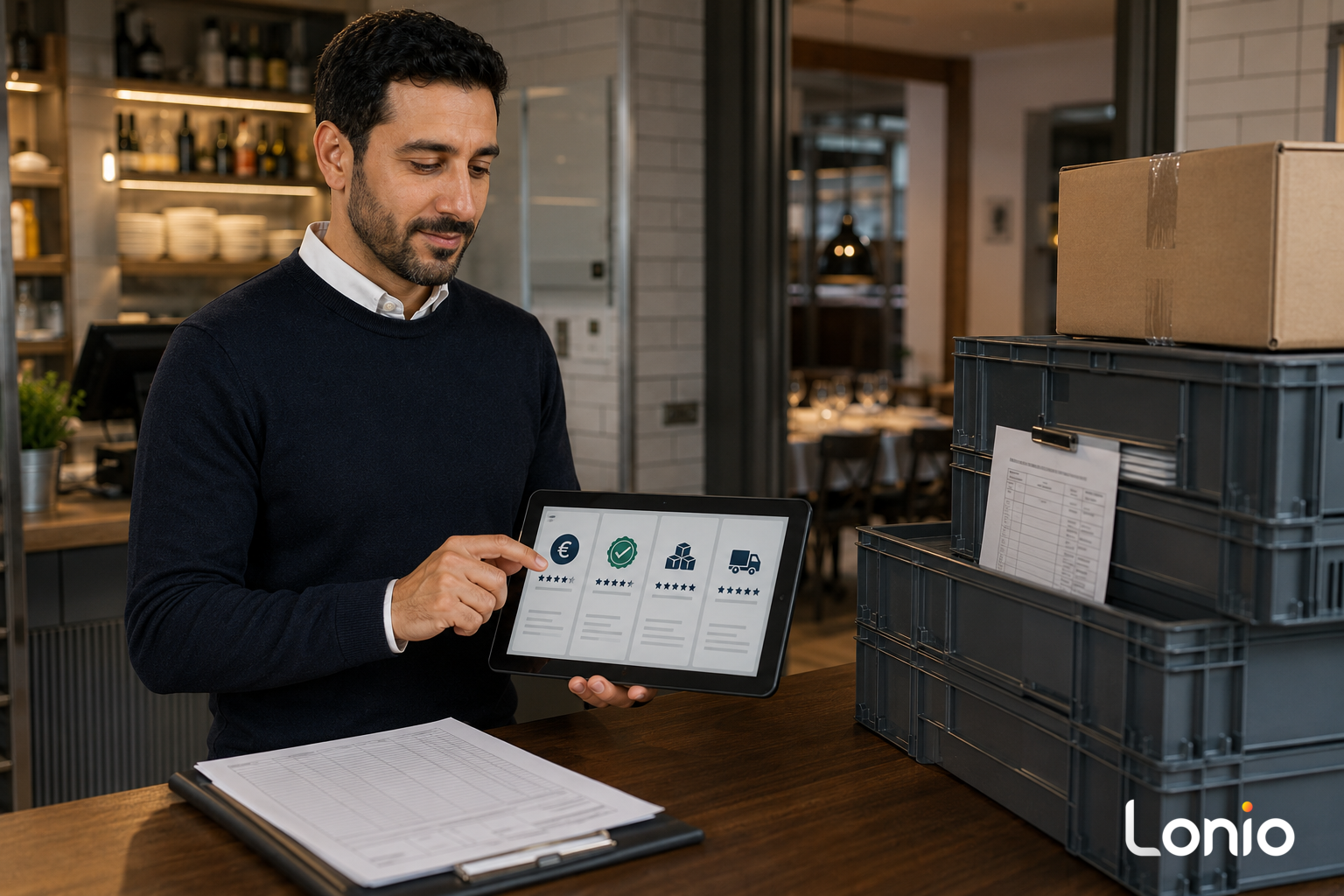
Choosing a supplier only by the lowest quoted price can lead to shortages, waste and unstable quality. A useful scorecard must be based on purchase orders, actual receipts and documented exceptions.
Link every receipt to the purchase order
Supplier evaluation starts with traceable records. The ordered item, quantity, agreed price, supplier, promised window, received quantity and acceptance result should belong to the same purchasing chain.
Compare prices in the same unit
A carton, pack, kilogram and usable portion cannot be compared without conversion. Include delivery charges, minimum-order rules, discounts and quality-related waste before concluding that one supplier is cheaper.
Separate promised arrival from completed receiving
Record the promised window, actual arrival and the time receiving checks were completed. A vehicle arriving at the site is not the same as goods being counted, inspected and moved into storage.
Account for the restaurant's receiving capacity
Several deliveries arriving together can create queues and incomplete checks. Staffing, unloading space, cold-storage capacity and other scheduled receipts should be considered so an internal delay is not incorrectly assigned to the supplier.
Measure on-time in-full delivery
OTIF asks whether the order arrived within the agreed window and in the confirmed quantity. An on-time but incomplete delivery and a complete but late delivery should remain separate outcomes.
Record quality and food-safety exceptions
Damage, unsuitable shelf life, temperature concerns, specification mismatch and rejected goods should be linked to the receipt with evidence. Acceptance and rejection rules must be defined by the restaurant's responsible quality or food-safety person.
Classify discrepancy severity
- Minor: small difference with no operational effect.
- Significant: shortage or delay requiring an emergency purchase or branch transfer.
- Critical: unsafe, sensitive or essential goods that stop production or sales.
Use a consistent classification so repeated serious issues are not hidden inside a simple exception count.
Weight the score before seeing results
Price, delivery, quality, discrepancy handling and responsiveness may have different weights. Set the weights in advance to prevent the scorecard being adjusted to justify a preferred supplier.
Run a corrective-action review
- Present period data and examples.
- Separate supplier causes from internal receiving causes.
- Assign an action, owner and deadline.
- Measure the result in the next period.
- Consider a backup supplier or revised terms if the issue continues.
Practical scenario
A supplier offers a competitive price but arrives late on three consecutive deliveries and sends incomplete quantities twice. Review shows that part of the delay came from overlapping delivery slots, while the shortages were genuine. The restaurant changes its receiving schedule, agrees a corrective plan and defines a backup source.
How Lonio can be assessed
Depending on the confirmed configuration, Lonio may support supplier records, purchase orders, goods receipts, discrepancy evidence and purchasing reports. Automated scorecards, delivery calendars or alerts should only be claimed after the actual product capability and data capture have been verified.
Conclusion
Regular supplier evaluation turns purchasing from a personal judgement into a measurable improvement process.
Frequently asked questions
Is the lowest price enough to choose a supplier?
No. Quality, delivery reliability, discrepancies, transport cost and operational impact must also be considered.
What does on-time in-full mean?
The order is received within the promised window and in the confirmed quantity.
Why does receiving capacity matter?
Overlapping deliveries can cause internal queues, incomplete checks and wrongly attributed delays.
How should supplier prices be compared?
Use the same unit and packaging basis and include transport, minimum orders, discounts and quality-related waste.