Cloud‑POS: Compare SLA, Uptime and Support for Austrian businesses
A practical technical and contractual guide for Austrian managers and buyers to compare uptime, SLA and support options for Cloud‑POS solutions.
- Bahram Davoodi
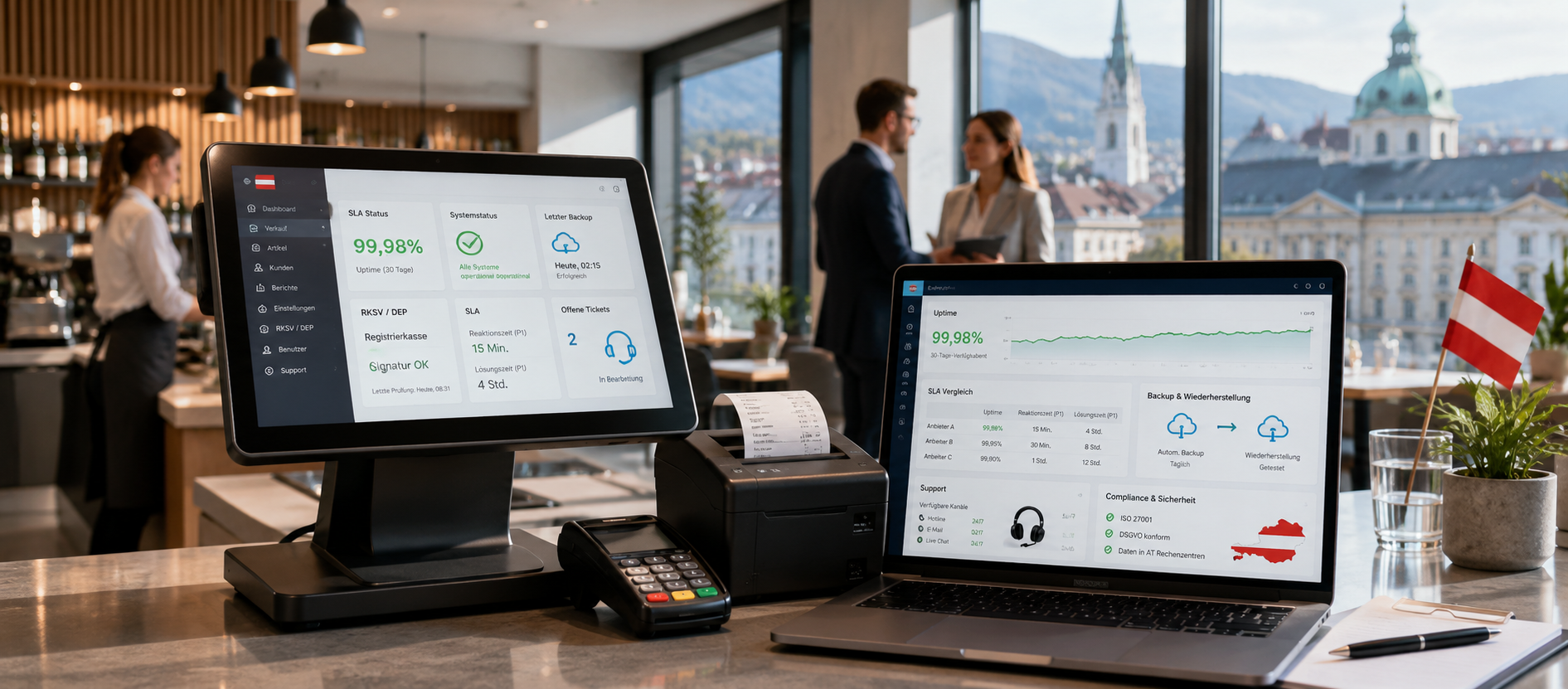
If you're selecting or switching a Cloud‑POS in Austria, the gap between marketing claims and contractual commitments (SLA) can directly affect daily sales, RKSV compliance and customer experience. This guide explains the practical and technical criteria for comparing uptime (service availability), support and recovery.
Why uptime and SLA matter for your business
“Uptime” is the percentage of time a system is available. For a retail shop or café, insufficient availability means lost sales, longer queues and the risk of incorrect transaction recording under the Austrian Registrierkassen rules (RKSV).
When reviewing Cloud‑POS contracts, check how the SLA is measured and reported: whether scheduled maintenance windows are excluded, how downtime is calculated, and under which conditions service credits or financial remedies apply.
Practical metrics to compare uptime
- Annual availability percentage (e.g. 99.9%): the practical difference between 99.9% and 99.99% can mean hours of additional interruption per year. Convert the SLA number into your business risk: estimated hours offline × cost per hour.
- Definition of downtime: does the SLA count local network outages, payment‑processor issues or only failures of the Cloud‑POS service itself?
- Maintenance windows: how and when are planned maintenance periods announced, and are high‑traffic periods excluded?
- Measurement and transparency: does the provider publish a public status page or provide verified uptime reports you can audit?
Support: levels, hours and channels
Technical support is one of the biggest drivers of mean time to recovery (MTTR) and hidden costs. Ask these questions when comparing providers:
- Support hours: is 24/7 support offered or only business‑hours support?
- Channels: phone, live chat, email or ticketing? How quickly is phone access available in a critical incident?
- Support response SLAs: what are the guaranteed initial response times and resolution targets (for example, initial response within 30 minutes for critical incidents)?
- Priority categorisation: how are incidents classified by impact and what escalation paths exist for urgent incidents?
Recovery and business continuity
Beyond day‑to‑day availability, review backup policies, the handling of the Datenerfassungsprotokoll (DEP) and formal recovery procedures. Key points:
- Does the provider keep regular, encrypted backups and what is the retention policy?
- What is the typical recovery time objective (RTO) and how much data could be lost (RPO)?
- Are recovery procedures tested periodically and are test reports shared with customers?
RKSV compliance and Austrian technical requirements
For Austrian businesses it is essential the Cloud‑POS supports RKSV obligations: correct transaction recording, secure retention of the DEP and using authorised mechanisms to preserve data integrity, such as the Signaturerstellungseinheit (signature creation unit) where applicable. Official sources and current interpretations can be found on Austrian government portals like RIS and tax services such as FinanzOnline.
A practical technical and contractual checklist
Use this checklist in vendor selection meetings:
- Request the written SLA and the claimed uptime percentage and clarify the measurement method.
- Ask for historical uptime reports or a public status page to review past performance.
- Define downtime precisely in the contract and list SLA exclusions.
- Document support response times and the escalation process.
- Request backup policies, RTO and RPO values and DEP retention details.
- Ask about recovery tests and request prior test results if available.
- Obtain written commitments about RKSV compliance and the provider’s role in maintaining transaction records.
Operational scenarios to guide your choice
Scenario 1 — a busy café with a morning peak: businesses that lose significant revenue from short outages should prefer higher‑availability SLAs (for example 99.99%), 24/7 phone support and short RTOs.
Scenario 2 — a seasonal clothing store: if sales concentrate in specific periods, ensure planned maintenance is scheduled outside peak windows and that service credits for interruptions are clearly defined.
Hidden costs and commercial metrics
Beyond the monthly subscription consider integration costs with hardware, data migration, staff training and the cost of downtime (lost sales and customer dissatisfaction). When estimating ROI include the probability of downtime and an average cost per hour of unavailability.
How Lonio can help
Lonio brings point‑of‑sale, inventory, reporting and support contacts into a single platform to shorten decision and recovery time. To compare proposed SLAs in practice and plan recovery tests, read more about our POS features and related services: POS features, Integrations and Reporting. For technical questions and migration help see Technical support and Data import & migration.
Next steps
Comparing Cloud‑POS offers by SLA, uptime, support response and recovery policy helps minimise operational and compliance risks. Before you sign, read SLA documentation, request historical uptime data and consult your accountant or tax advisor about RKSV implications.
Frequently asked questions
1) What uptime level is appropriate for a small business in Austria?
For businesses with high daily transaction volume a minimum SLA of 99.9% is reasonable; many choose 99.95–99.99% depending on the cost per hour of downtime and operational sensitivity.
2) How can I ensure a provider supports RKSV requirements?
Ask for technical documentation showing how the DEP is retained, how transactions are recorded and what signature mechanism is used (Signaturerstellungseinheit or an approved electronic signing method). Verify the provider’s statements against official guidance such as RIS or consult a tax advisor.
3) What should I expect if a provider breaches the SLA?
Your contract should define how downtime is calculated and outline remedies such as service credits or financial compensation. Review these terms carefully and consider asking for a recovery‑test or trial period if operational risk is high.