Offering tax-free shopping in Austria: eligibility, process and refunds
Offering tax-free shopping requires a clear process from purchase to confirmed export and refund. This guide explains the Austrian rules and support available from Lonio.
- Bahram Davoodi
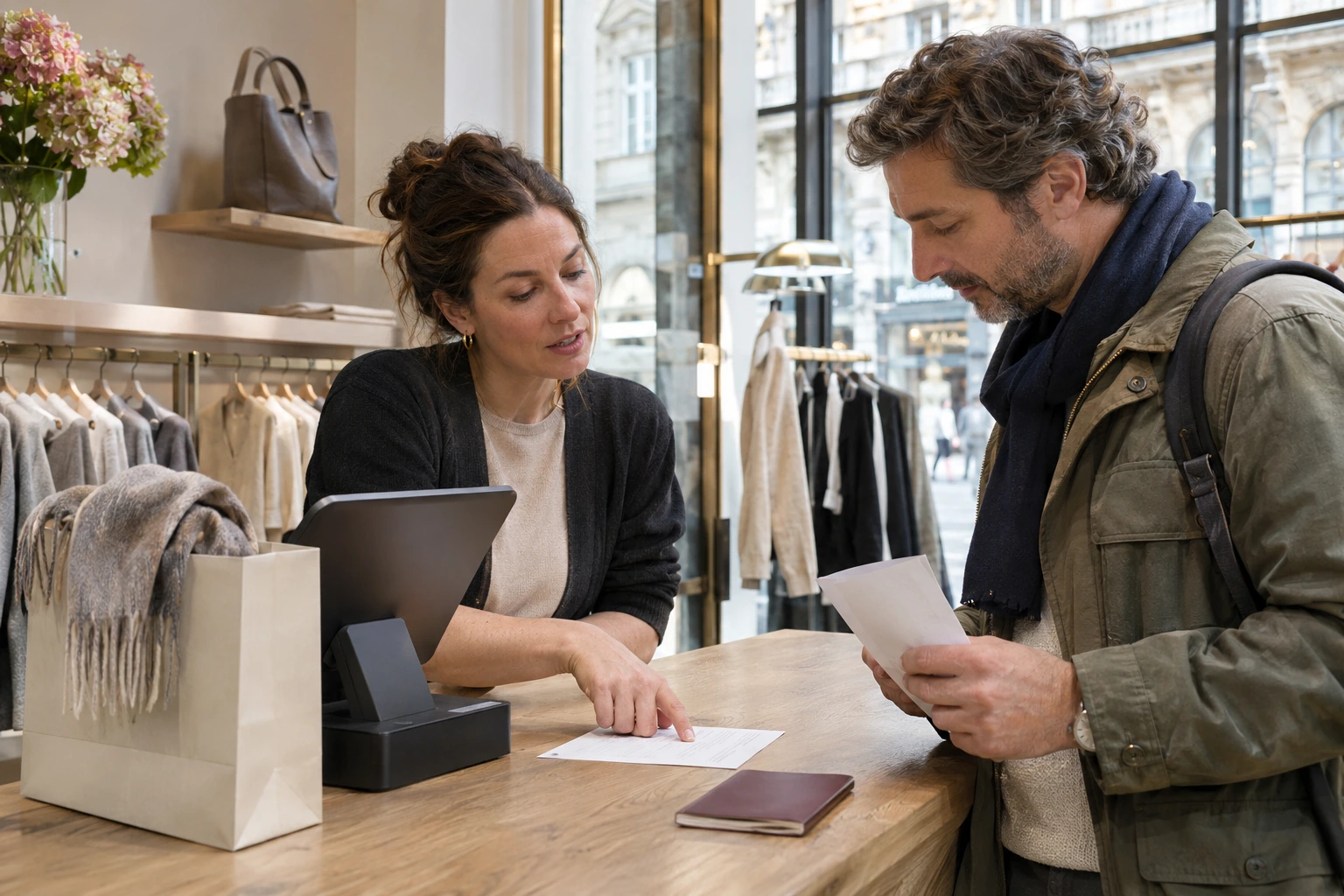
Tax-free shopping can allow travellers to reclaim VAT on goods bought in Austria and taken out of the EU in their personal luggage, provided the conditions are met. For retailers, this involves four separate tasks: checking eligibility, issuing documents, obtaining proof of export, and completing the refund and accounting. A tax-free form alone confirms neither export nor payment of a refund.
Lonio supports tax-free shopping. You can offer this service in your shop and agree the intended process with Lonio. This guide explains what matters for Austrian retailers, from the first question at the till to the completed transaction.
Who can use tax-free shopping in Austria?
Nationality alone is not the deciding factor. The buyer must have neither a residence nor habitual residence in the EU. A foreign passport is therefore not enough: someone holding a non-EU passport may live in Austria and fail to meet the condition.
The goods must be bought for private use and exported in personal luggage. The legal basis is the tourist export rules in section 7 of the Austrian VAT Act.
Check in the shop | What matters |
|---|---|
Buyer | No residence or habitual residence in the EU; check the appropriate travel documents |
Purchase | Goods for private use that will be exported in personal luggage |
Invoice total | More than €75 on the individual invoice, meaning at least €75.01 |
Export deadline | No later than the end of the third calendar month after the month of supply |
Evidence | Confirmed export and traceable records held by the retailer |
Two separate invoices for €40 and €50 do not meet the threshold simply because they add up to €90. Assess each document against the applicable requirements. Special territories and unclear residence information need separate checking.
Which businesses is this relevant to?
Typical purchases include clothing, shoes, jewellery, accessories and other goods travellers can carry with them. A hotel stay, restaurant meal or haircut does not become a tourist export because of the guest's place of residence. If a salon also sells suitable care products, assess that sale of goods separately from the treatment.
A parcel sent by a freight carrier is not a tourist export in personal luggage either. Other export supplies follow their own procedures. Do not combine ordinary online shop shipping with the tax-free process for travellers.
The process: from purchase to refund
1. Ask the right questions before payment
Establish whether the customer wants to use tax-free shopping, where they live and whether they will take the goods out of the EU themselves. Check the travel documents required for the intended evidence. Explain in advance how the confirmation will be returned, who handles the refund and whether the agreed terms include any fees.
A consistent procedure helps the team. Another employee should be able to take over without asking the customer to repeat information that has already been established.
2. Issue the appropriate invoice and export documents
The invoice, buyer details and goods must match. Depending on the procedure, a U34 form, an equivalent form or a suitable invoice can provide the basis. The Ministry of Finance guidance explains the required confirmation and how it is returned.
Agree the tax treatment and invoice format with your accountant or accounting team before the first tax-free sale. There are different approaches to when the exemption is recognised. Simply adding a discount to an invoice after it has been issued does not reliably record this process. Incorrectly showing VAT on an exempt invoice can also have consequences.
3. State the export deadline precisely
For goods supplied on 21 November 2026, export from the EU must take place by 28 February 2027. The rule refers to the three following calendar months, not a flat 90 days or three months from the invoice date.
Do not confuse the deadline for physically exporting the goods with conditions for submitting documents or processing a refund. Give the customer both sets of information clearly and separately.
4. Have the export confirmed at the right place
In principle, the customs office at the point of departure from the EU is responsible; it may be in another member state. Goods and documents must be available for inspection. For connecting journeys, travellers should check in advance where they need to present the goods, taking account of their luggage and route.
At Vienna Airport, digital export validation is handled through DEV. Goods in checked baggage are validated before the baggage is handed over; for hand luggage, the airport specifies validation after security. These instructions describe Vienna and do not replace guidance for other departure points.
5. Complete the evidence, payment and accounting
Link the confirmed evidence to the original sale. Record whether documents are still missing, the refund has been authorised or payment has been made. Export confirmation is not proof that a refund has been paid.
The Austrian Economic Chamber explains the tax procedure, including invoice corrections and accounting evidence. Agree who is responsible for open cases and corrections. If goods are returned later, the tax-free transaction and any refund already processed also need to be reviewed.
How much does the customer receive?
A VAT rate of 20% does not mean a refund of 20% of the gross price. In this hypothetical example, an item costs €240 including 20% VAT:
Calculation | Amount |
|---|---|
Net price: 240 ÷ 1.20 | €200 |
VAT included: 240 − 200 | €40 |
The tax included is therefore approximately 16.67% of the gross price. The actual payment may be lower because of agreed processing fees. Other VAT rates produce different amounts. Do not promise a flat refund percentage before the tax rate, procedure and conditions are clear.
Offer tax-free shopping with Lonio
Lonio supports tax-free shopping for retailers. The platform also connects the till and sales, customer management and accounting. When setting up your tax-free process, agree which information will be recorded, which documents will be used and how enquiries, export evidence and refunds will be handled.
Bring a typical basket and your intended process to a personal consultation. Work through a complete example, including a missing confirmation or a return. Support from Lonio does not replace the required export confirmation or mean automatic customs approval.
Frequently asked questions
Is a purchase of exactly €75 enough?
No. The invoice total must exceed €75. A total of €75.01 meets the value threshold, but the other conditions must also be satisfied.
Is the refund automatically completed at the airport?
No. Export validation and payment are separate steps. The agreed procedure with the retailer or refund provider determines what happens next.
Can an EU resident use tax-free shopping if they hold a different passport?
Nationality alone is not enough. For this tourist export procedure, the buyer must have neither a residence nor habitual residence in the EU.
Does Lonio support tax-free shopping?
Yes. Lonio supports tax-free shopping for retailers. Agree the specific process and setup for your business with the Lonio team.