19% VAT in Jungholz and Kleinwalsertal: setting up your cash register correctly
A local address alone does not justify 19% VAT. Learn which conditions and exceptions apply, and how to keep 19% and 4.9% separate when configuring your cash register.
- Bahram Davoodi
Last updated: 21 November 2026. This article covers Austrian VAT and the technical configuration of a cash register.
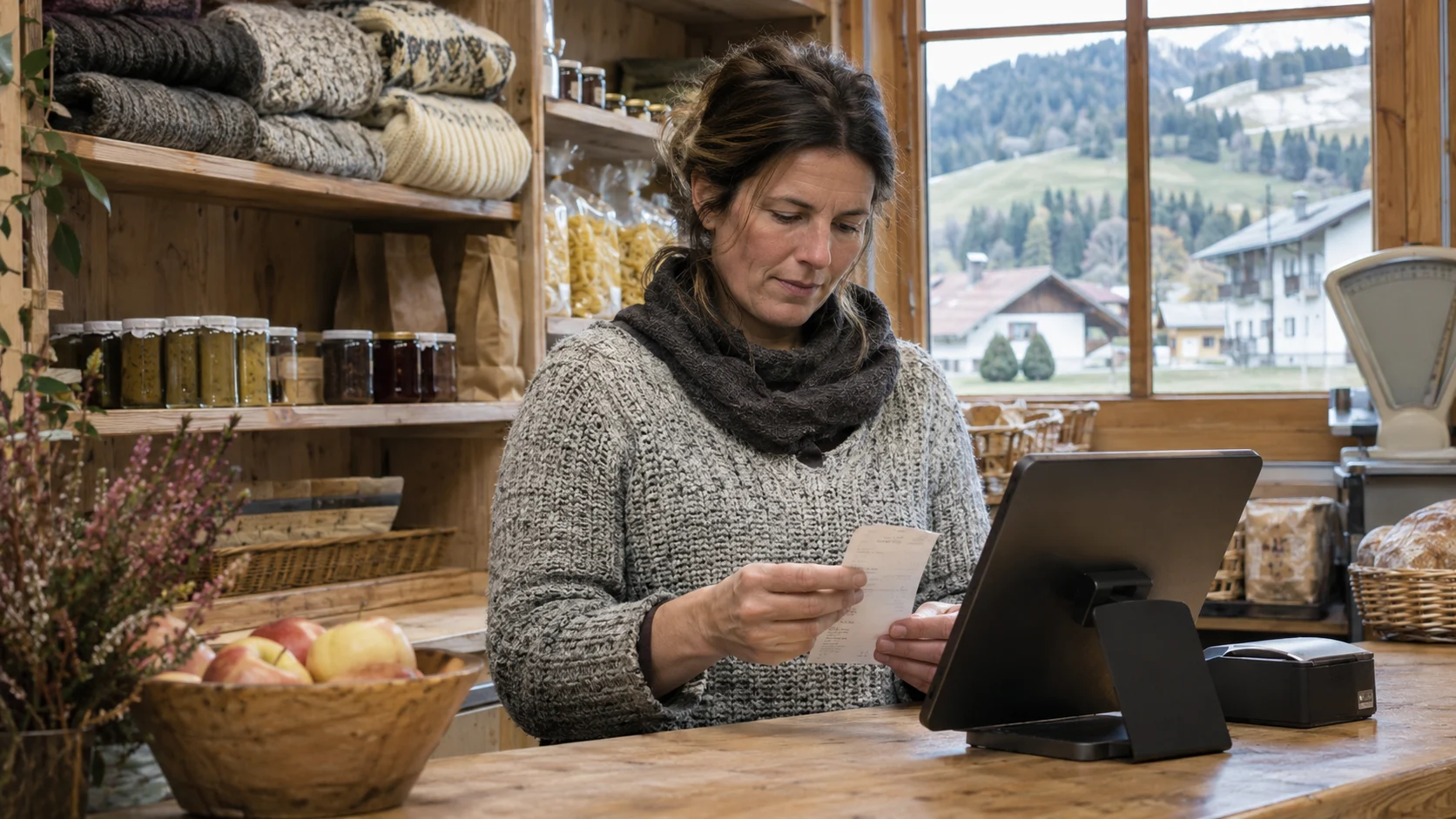
A VAT rate of 19% can apply to certain transactions in Jungholz and within the municipality of Mittelberg in Kleinwalsertal. What matters is where the transaction takes place, the business's local connection and the type of supply. A customer's address in Kleinwalsertal is not enough. Nor should a business based there simply change its entire product range to 19%.
Since July 2026, there has been another distinction to make when configuring the cash register: 19% and the new 4.9% rate are recorded in the same technical amount field under the Austrian Cash Register Security Regulation, known as the RKSV. For tax purposes, they remain two different rates.
Which areas does the rule cover?
Section 10(4) of the Austrian VAT Act (UStG) names Jungholz in Tyrol and Mittelberg in Vorarlberg. The municipality of Mittelberg includes the villages of Riezlern, Hirschegg and Mittelberg in Kleinwalsertal. The rule does not apply generally to Tyrol, Vorarlberg or businesses near the German border.
For transactions to qualify, the business must have a residence or registered office, habitual residence or permanent establishment in these areas. The transaction in question must also take place there. The Austrian rule therefore cannot be determined solely by a postcode or a customer's nationality. [1, 4]
When does 19% apply — and when does it not?
The provision contains exceptions. Supplies and rentals of motor vehicles to recipients whose residence or registered office is elsewhere in Austria are excluded. Transactions supplied to a business's permanent establishment elsewhere in Austria are also excluded.
Transactions covered by section 10(1a), (2) or (3) retain their applicable rate of 4.9%, 10% or 13%. Tax exemptions and special circumstances also need to be assessed separately. The regional 19% rule alone cannot determine the treatment of imports or cross-border transactions. [1]
Example subject to the conditions above | Treatment |
|---|---|
A clothing retailer liable for VAT, with a permanent establishment in Mittelberg, sells ordinary clothing on site to a private customer; no other exception applies. | This transaction may qualify for 19%. A net price of €100 gives €19 in VAT and a gross price of €119. |
A hotel in the same area provides qualifying accommodation in a furnished living or sleeping space. | The applicable 10% rate for this service remains in place. For additional services or packages, check whether they share this rate or require different treatment. |
A local business rents a motor vehicle to a private customer who lives in Vienna. | The regional concession is expressly excluded; in an ordinary taxable case, the standard rate of 20% applies. |
These examples do not replace an assessment of your specific transaction. Particularly where multiple locations, supplies or service packages are involved, the tax treatment should be established before configuration begins. [1, 5]
19% and 4.9%: the same RKSV field, different tax rates
Since 1 July 2026, the 4.9% rate has applied to the goods specified by law in Annex 3 to the UStG. It does not apply to all food indiscriminately and does not generally replace the VAT rate for restaurant services. [1, 5]
The current Annex 1 to the RKSV assigns both 19% and 4.9% to the field Betrag-Satz-Besonders. This is a technical aggregation of gross amounts in the signed cash register data. It must not become a shared tax category with a single VAT rate. On the receipt, payment amounts must be separated according to the rates actually applied; other records must also preserve the correct allocation. [2, 3]
A calculation using two items that have already been classified correctly:
Item | Net | VAT | Gross |
|---|---|---|---|
Item taxed at 19% | €100.00 | €19.00 | €119.00 |
Qualifying item taxed at 4.9% | €100.00 | €4.90 | €104.90 |
Total | €200.00 | €23.90 | €223.90 |
In the relevant technical amount field, these items add up to €223.90 gross. For the tax breakdown, €19.00 and €4.90 remain separately identifiable. This example explains the calculation; it is not an issued or independently tested Lonio receipt.
What to check before your first sale
- Record the location and transaction. Which permanent establishment is making the sale, where is the service provided, and does an exception apply?
- Set up separate tax categories. A technical RKSV mapping does not replace the substantive distinction between 19% and 4.9%.
- Assign products and services. The classification must match the specific offering; a general group such as “food” is not always sufficient.
- Check a mixed-rate transaction in the test system. Verify net amounts, VAT, gross amounts and the breakdown for each rate. Also work through a discount and a cancellation where these occur in your business.
- Reconcile receipts and reports. The breakdown must remain traceable through to the handover to accounting. Check that a change to the product configuration does not retrospectively alter completed receipts.
The 19% tax category in Lonio
Lonio supports the configuration of a 19% tax category for transactions that fall within that classification. As an integrated business platform, Lonio connects sales, stock, online shopping and accounting, among other functions. The tax classification of your business remains the basis for its specific configuration.
For a business in Jungholz or Mittelberg, we can work through a suitable example sale together: the tax categories required, how they appear on the receipt and the reports intended for the business. This particular workflow should be checked before going live, especially when different VAT rates are used together.
Discuss the setup for my business · Explore cash register features
Frequently asked questions
Is the customer's postcode enough to apply 19%?
No. The regional rule also requires a local connection for the business making the supply and a transaction taking place in that area. Automatic allocation based only on the delivery or billing address would be too broad.
Does 19% apply to every sale in Kleinwalsertal?
No. The statutory rates of 4.9%, 10% and 13%, along with exceptions and exemptions, must be considered separately.
Can the cash register combine 19% and 4.9% into one VAT rate?
No. The shared RKSV amount field is a technical requirement. The actual VAT rates and their corresponding amounts must remain distinguishable on receipts and in records.
Does the 19% rate mean that German VAT law applies in full?
No. The 19% rule explained here is part of the Austrian UStG. Cross-border transactions and imports require their own assessment.
For more background, see the overview of Austrian VAT rates at the cash register.
Sources and notes
- RIS: Austrian VAT Act 1994, particularly section 10(1a) to (4).
- RIS: RKSV, Annex 1 — technical allocation of amounts and section 11 — information on receipts.
- BMF: Information on the VAT reduction for selected food products, section on cash registers. Some passages date from the legislative preparation stage; the legislation currently in force takes precedence.
- Municipality of Mittelberg: Welcome to Kleinwalsertal.
- WKO: Reduced VAT rates.
This article provides general information. The classification of your specific transactions should be clarified with your tax adviser. Product support and tax assessment are separate matters.