Online booking for Austrian hair salons: from appointment to payment
An empty appointment and a sale entered twice are different problems. Here is how a salon can measure unused time and connect booking, checkout, stock and accounting.
- Bahram Davoodi

At 14:00, one chair is empty. The customer has not arrived, another person is asking for an appointment by phone, and the receptionist cannot tell whether the booking was confirmed. Later, a haircut and a bottle of shampoo are entered again at checkout.
These are two different problems: unfilled time and repeated administration. An online booking system is useful when it helps the team handle both. For an Austrian hair salon or barbershop, the aim is a continuous record from available appointment to completed visit, payment and next booking.
Start with time you can actually sell
Before opening an online calendar, define a small, accurate service list. A cut, a colour consultation and a combined treatment need different durations. Include preparation or clean-up time where your team needs it. A gap in the calendar is only bookable if the right person and resources are available.
Run three checks before launch:
- Can a customer choose a service and an available team member without calling to clarify what they booked?
- Does a telephone booking immediately block the same time from online selection?
- What happens when a longer treatment overlaps a break, an absence or the next appointment?
Lonio's appointment and reservation tools support resources, durations, blocked times and configurable online availability. Test those settings against your own timetable. Do not assume that every service should be bookable without a preliminary conversation.
Put a realistic value on an empty appointment
A missed appointment is not automatically a loss equal to its advertised price. Some costs are avoided; others continue. Start with the contribution the appointment would have made towards wages, rent and other overheads.
Illustrative planning example, not a salon benchmark or a promised result:
Assumption | Amount |
|---|---|
Net service revenue per appointment, excluding VAT | €60 |
Variable costs avoided if it does not take place | €8 |
Contribution at risk per unfilled appointment | €52 |
Eight unfilled appointments in a month | €416 |
At 45 minutes each | 6 hours of unfilled booked time |
The calculation is €60 − €8 = €52; eight such appointments put €416 of contribution at risk. This is not a calculation of net profit. Wages and rent have not been deducted, and you should not subtract them twice. If three of those slots are filled with equivalent appointments, the contribution recovered would be €156 before any additional costs.
Use your own service mix and record whether a cancellation was actually refilled. A cancellation received early enough to reuse the time has a different business impact from a no-show.
Make changes easy to handle
Give customers a clear booking confirmation, a practical way to contact the salon and understandable arrangements for changes. Decide who checks incoming changes and who releases an unused slot. A reminder is only useful if the recipient details and timing are correct.
Lonio documents configurable confirmations, changes and reminders. Check the available delivery channels, configuration and any associated costs in your proposed setup; do not assume that every message is an included SMS.
If you want deposits or cancellation charges, agree the booking and refund process first and have the terms checked for your situation. A charge should not appear as a surprise when the customer cancels.
Carry the visit into checkout
At the chair, the service can change. A customer may add a treatment or buy a retail product. Record what was actually delivered before taking payment, and retain the link to the appointment.
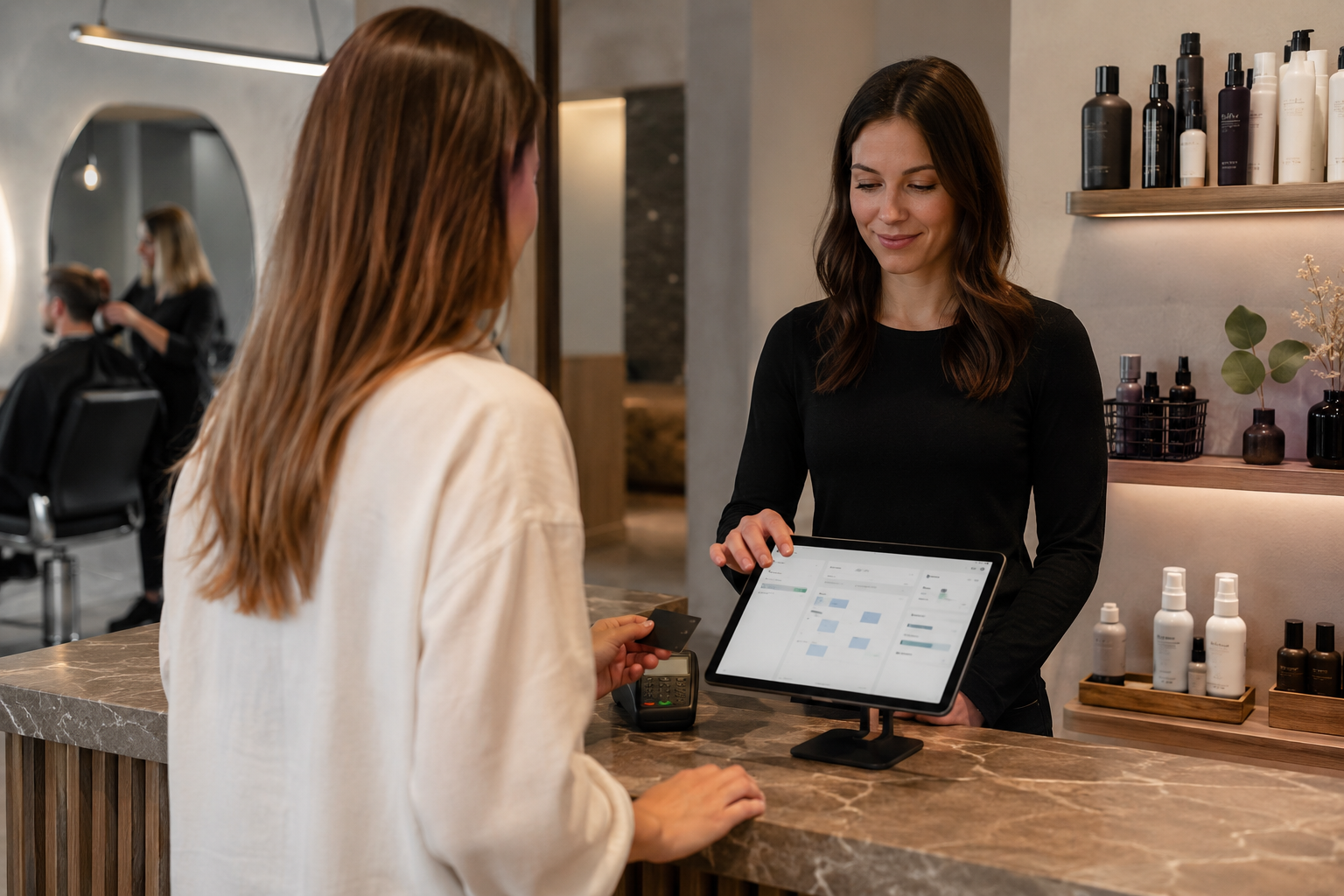
For your trial, use one haircut and one shampoo bottle. Transfer the appointment to the sale, add the bottle, take payment and inspect the receipt. Then check that the completed visit can be found again without opening a second customer record. Lonio's salon workflow connects appointments with services, products and billing.
Keep retail stock separate from products consumed during treatments. Selling a sealed bottle and using part of a colour tube are different inventory events. Agree how consumption will be recorded; do not assume that each booked service automatically deducts ingredients. The inventory tools provide a place to follow stock movements and reconcile counts.
Keep the customer history useful
The next visit should start with the right customer record. Check that purchases, relevant contact details and any open transactions are easy for authorised staff to find. Lonio's customer management brings contact information, orders and customer balances together.
Store information that serves a clear purpose and limit access according to staff responsibilities. Keep appointment communication and promotional campaigns distinct. Before sending an offer, check the customer's recorded communication permissions; having their phone number for an appointment is not a sensible substitute for that check.
An integrated website or product shop can extend the same relationship between visits. Introduce it when someone on the team can maintain the service descriptions, availability and products.
Finish the test in the accounts
A successful card payment is not the end of the workflow. Locate the sale, its payment method and the corresponding record for your accountant. Include a refund in the trial and check that it remains traceable.
Lonio's accounting features connect sales, purchasing and payment records. Accounting exports and full accounting are different scopes. Agree the required export and account mappings with your accountant before the first live month.
A practical first-month check
Before comparing subscriptions, ask for a demonstration of one complete visit: online booking, telephone change, reminder, added product, payment, stock movement and accounting record. Include the people who will use the system daily. Confirm the available features and costs against the current package comparison.
For the first month, track unfilled appointment hours, refilled cancellations and corrections made after checkout. These are more useful starting points than an assumed percentage improvement. Review them with the team, adjust service durations and fix the step causing the most repeated work. For the wider register-selection requirements, use the Austrian salon POS guide.