RKSV and Registrierkassenpflicht in Austria: A Complete Guide to a Legal Registrierkasse
A practical, plain-English guide to Austria's RKSV and Registrierkassenpflicht: who is affected, what the rules require technically, what changes in 2026, the penalties for getting it wrong, and how the right cash register system keeps you compliant.
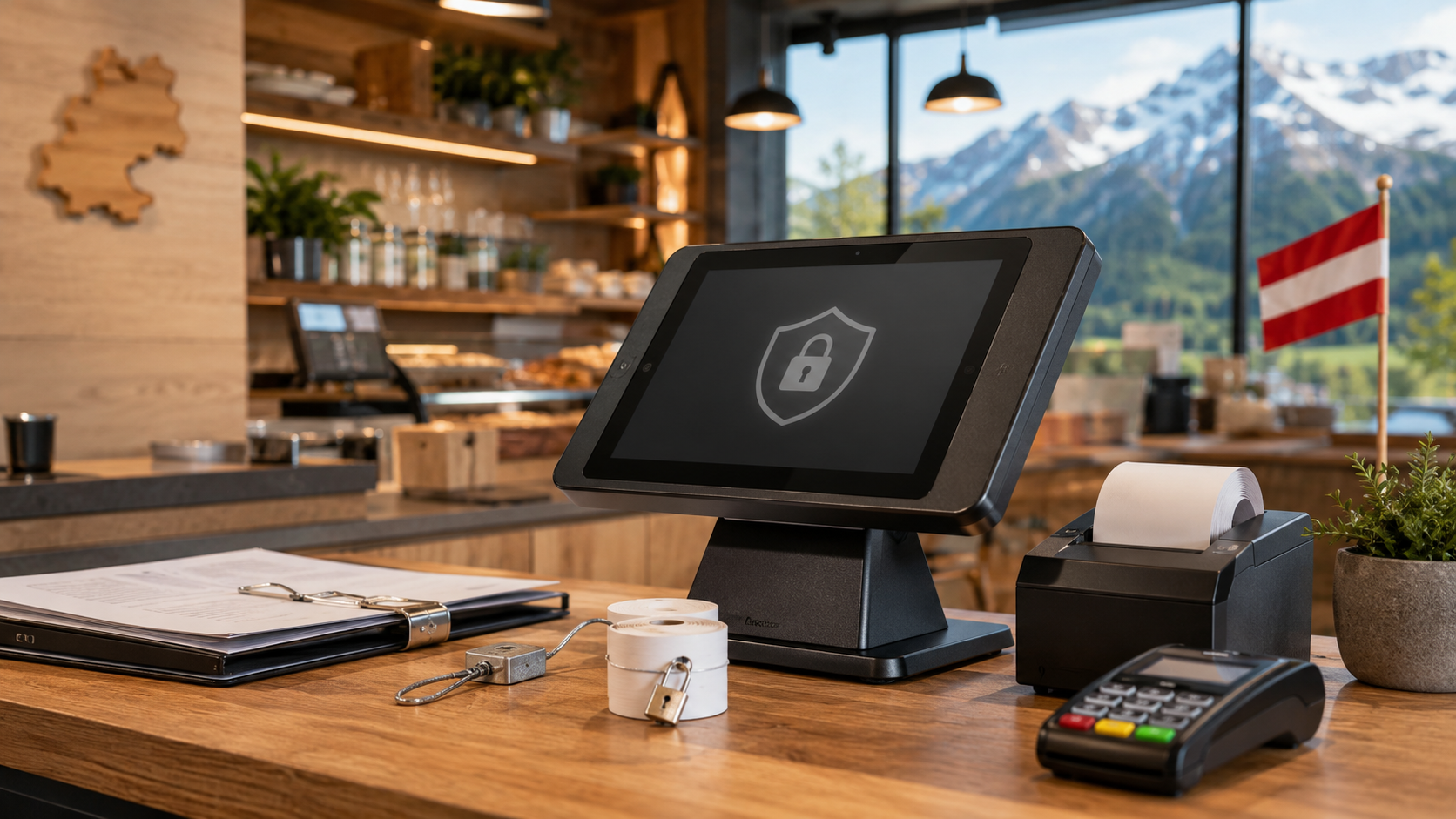
If you run a business in Austria that takes cash, sooner or later you will run into two terms that decide how your till has to work: the Registrierkassenpflicht (the legal obligation to use a registered cash register system) and the RKSV, short for Registrierkassensicherheitsverordnung (the Cash Register Security Regulation). Together these two rules form the backbone of operating a compliant Kassensystem (point-of-sale and cash register system) in Austria. This guide walks through who is affected, what the RKSV actually demands on a technical level, what the Belegerteilungspflicht (receipt-issuing obligation) means in practice, what is changing in 2026, the penalties for ignoring the rules, and how the right system turns all of this from a headache into a background task.
This article is for general information only and is not binding legal or tax advice. Rules and thresholds can change and every business is different, so always confirm your specific situation with a Steuerberater (tax adviser) or another qualified professional before you act.
The two rules that shape every Austrian till
It helps to keep the two concepts apart from the start, because people often blur them together:
- Registrierkassenpflicht — the obligation to have and use an electronic cash register once your business passes certain turnover thresholds.
- RKSV — the technical security rules that a Registrierkasse must meet so that recorded sales cannot be manipulated after the fact.
Think of it this way: the Registrierkassenpflicht tells you whether you need a compliant till, and the RKSV tells you how that till has to be built and secured. Bolted on top of both is the Belegerteilungspflicht, the duty to hand a receipt to every customer. Get all three right and a tax audit becomes a formality rather than a threat.
Who actually needs a Registrierkasse?
In most cases, the Registrierkassenpflicht kicks in when both of the following are true in a financial year:
- Your annual turnover (Umsatz) exceeds EUR 15,000, and
- Your annual cash turnover (Barumsatz) exceeds EUR 7,500.
The crucial detail that catches a lot of business owners out is what counts as "cash". Under the Austrian rules, "cash sales" are not just notes and coins. They also include payments by debit and credit card, by mobile payment apps, and other cash-equivalent instruments settled on the spot. So a café that takes almost everything by card can still comfortably clear the EUR 7,500 cash threshold and fall under the obligation.
Once you cross both limits, the obligation typically applies from a defined point in the following months rather than instantly — another good reason to talk to a Steuerberater as you approach the thresholds, so you are ready before the deadline rather than scrambling afterwards.
Belegerteilungspflicht: a receipt for every single sale
The Belegerteilungspflicht is the receipt-issuing obligation, and it is broader than many people expect. It requires you to issue a receipt for every cash transaction, from your very first sale — and, importantly, it applies even if you are below the Registrierkasse thresholds above.
In practice that means two duties sit side by side:
- You must issue a receipt to the customer for each transaction.
- The customer is expected to accept the receipt and, in principle, keep it until they leave the premises.
A compliant receipt is not just a scrap of paper. Once you are inside the RKSV regime, each receipt has to carry specific machine-readable information — including a QR code generated from the digital signature — that ties the individual sale back to the secured record in your till. This is what lets an auditor confirm on the spot that a receipt is genuine and part of an unbroken chain.
What the RKSV requires, in plain terms
The RKSV is where the technical detail lives. Its whole purpose is to make sure that once a sale has been recorded, it cannot be quietly deleted or altered later. A compliant Registrierkasse has to bring several components together:
- Signaturerstellungseinheit — a signature-creation unit (a secure hardware or cloud-based signature device or certificate) that digitally signs every transaction. This digital signature is the anchor of the whole system.
- DEP (Datenerfassungsprotokoll) — the data collection log, a tamper-evident chain in which each sale is cryptographically linked to the previous one. Because every entry depends on the one before it, removing or editing a single sale breaks the chain and becomes detectable.
- Registration in FinanzOnline — both the signature-creation unit and the cash register itself must be registered with the tax authority through FinanzOnline, Austria's online tax portal.
- Startbeleg — a start receipt created when you commission the till, which is verified to confirm the system is set up correctly.
- Periodic and annual checks — including the monthly and, in particular, the year-end receipt (Jahresbeleg), which has to be created and verified, for example using the tax authority's app, at the close of each year.
None of this is meant to be assembled by hand. A cash register system built for the Austrian market provides the signature, the DEP chain, the FinanzOnline registration flow, the start and year-end receipts and the ongoing checks as one integrated package. A well-designed Austrian cash register and POS system handles these requirements for you so you can focus on serving customers rather than managing cryptography.
What is changing in 2026
The framework is stable in its essentials, but a few adjustments are worth watching for 2026. Treat the following as direction of travel rather than final figures, and confirm the specifics against official sources before you rely on them:
- Higher Kalte-Hände-Regelung threshold. The "cold hands" rule, a simplification for genuinely mobile, open-air trading (think market stalls and similar outdoor sales), is set to see its turnover limit rise from EUR 30,000 to EUR 45,000. Businesses under this limit can use simplified cash records instead of a full Registrierkasse.
- Kleinunternehmer relief. Continued and, in places, expanded simplifications for small businesses (Kleinunternehmer) operating below the small-business turnover limits.
- A shift towards digital receipts. A clear move to make electronic receipts a first-class, fully accepted alternative to paper — better for costs, sustainability and customer experience alike.
Because thresholds and effective dates can move, follow the official channels (linked at the end of this article) and check with your tax adviser rather than acting on summaries alone.
The penalties for getting it wrong
Ignoring the Registrierkassenpflicht, the RKSV or the Belegerteilungspflicht is not a low-risk gamble. The consequences can include:
- Financial penalties for failing to use a compliant register or to issue receipts.
- Serious complications during a tax audit — if your records cannot be shown to be complete and tamper-evident, the tax authority may question your figures and estimate your turnover, which rarely works in your favour.
- Reputational and operational disruption if problems surface during an inspection while customers are present.
The reassuring flip side is that compliance is largely a solved problem once you are on the right system: the till does the hard part automatically, and an audit becomes a matter of exporting the records rather than defending them.
How a good Kassensystem makes compliance effortless
The practical takeaway is that the right cash register system removes almost all of the manual burden. When you are choosing one for the Austrian market, look for a Kassensystem that:
- Supports the digital signature (Signaturerstellungseinheit) and maintains the DEP chain automatically, so every sale is signed and linked without you thinking about it.
- Makes it easy to issue compliant receipts, on paper or digitally, complete with the required QR code.
- Handles the FinanzOnline registration steps and generates the start and year-end receipts on schedule.
- Provides clear reports and a reliable Tagesabschluss (daily closing summary) so your day always balances.
- Offers clean exports for your accounting and for digital invoicing, so nothing has to be re-keyed.
- Comes with responsive technical support for the moments when you need a quick answer.
Choosing a system that treats RKSV compliance as a built-in default, rather than an add-on you have to configure yourself, is the single biggest thing you can do to keep the whole obligation off your plate.
Where Lonio fits in
Lonio connects your cash register, inventory, sales, customers, invoicing and reporting in one place, so the compliance pieces and the day-to-day running of your business stop living in separate silos. Instead of stitching together a till, a stock sheet and an accounting export, you get one system where a sale flows straight through to your records and reports. If you would like to see how that works for an Austrian business like yours, get in touch for a demo.
Official sources
For the authoritative detail — and to confirm the latest thresholds and dates — go straight to the Austrian authorities:
- USP (Unternehmensserviceportal) — Registrierkassen
- BMF (Federal Ministry of Finance) — Cash register and receipt-issuing obligation
- WKO (Austrian Economic Chambers) — Registrierkassen and Belegerteilungspflicht
The bottom line
RKSV and the Registrierkassenpflicht are the foundation of running a till legally in Austria, with the Belegerteilungspflicht sitting on top as your everyday receipt duty. The rules are detailed, but they are entirely manageable — and the choice of the right Kassensystem is what turns compliance from an ongoing worry into something that simply happens in the background. Confirm your own position with a Steuerberater, pick a system built for the Austrian rules, and you can get back to running your business.
Frequently asked questions
From what point do I need a Registrierkasse?
Typically once you exceed both EUR 15,000 in annual turnover (Umsatz) and EUR 7,500 in annual cash turnover (Barumsatz) — remembering that card and mobile payments count as "cash". Because the obligation then applies from a defined date, check your exact position and timing with a tax adviser (Steuerberater).
What is the difference between the RKSV and the Belegerteilungspflicht?
The RKSV sets the technical security requirements for your cash register — the digital signature, the tamper-evident DEP chain and FinanzOnline registration. The Belegerteilungspflicht is the separate obligation to issue a receipt for every cash sale, starting from your very first transaction and even below the Registrierkasse thresholds.
Does the software guarantee that I am compliant?
A good Kassensystem provides everything you need to meet the requirements — the signature, the DEP, compliant receipts and the FinanzOnline steps — but no software can promise blanket compliance without regard to your specific setup and how you use it. Treat it as the right foundation and confirm your individual case with a Steuerberater.
What changes in 2026?
The main expected changes are an increase in the Kalte-Hände-Regelung threshold to EUR 45,000 for mobile open-air trading, continued relief for small businesses (Kleinunternehmer), and a stronger move towards fully accepted digital receipts. Confirm the final figures and dates against the official sources.