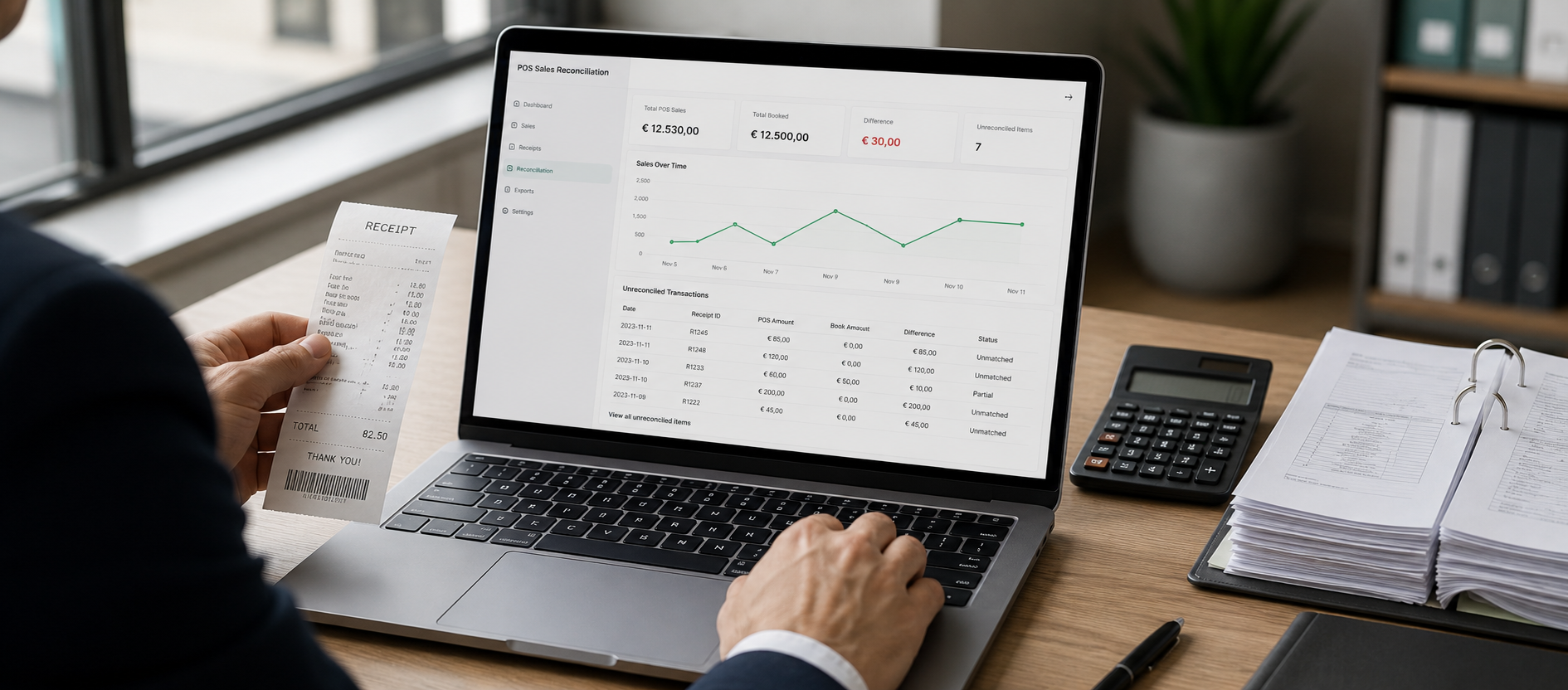
Cash register down: what to do in Austria?
Security device or the entire register down? Handwritten receipts, re-entering sales, the collective receipt and the FinanzOnline report after 48 hours – an overview.
- Bahram Davoodi
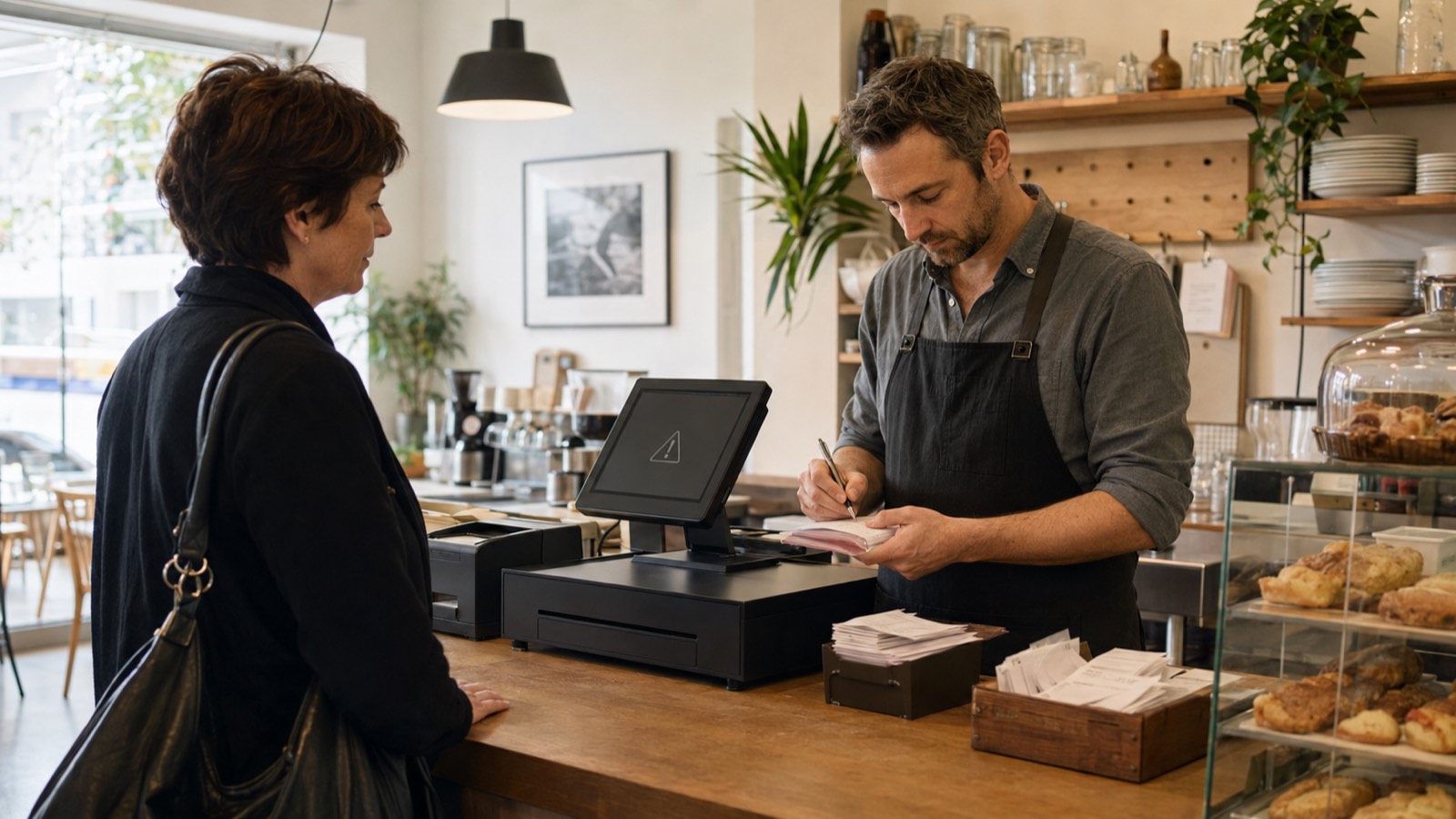
Cash registers tend to fail exactly when your business is at its busiest: a power outage, faulty hardware, a dropped connection, or a problem with the security device. When that happens, the most important things for your team are to stay calm, document the outage, and follow a clear procedure.
In this article, you will learn what to keep in mind when a cash register fails in Austria, when handwritten receipts are required, and under which conditions a report via FinanzOnline becomes necessary.
First things first: what exactly has failed?
For the next steps, it is crucial to determine whether the cash register itself is affected or only the signature or seal creation unit (Signatur- bzw. Siegelerstellungseinheit).
Only the security device has failed
If only the signature or seal creation unit is out of order, the cash register can generally still be used. During this time, however, every receipt you issue must carry the notice
„Sicherheitseinrichtung ausgefallen“ (security device failed)
printed on it.
Once the security device is restored, you must create the collective receipt (Sammelbeleg) required under the cash register security regulation (Registrierkassensicherheitsverordnung, RKSV).
The cash register itself has failed
If the entire cash register fails, cash sales should, where possible, be recorded on another working cash register.
If no other register is available, you may document the sales by hand. A duplicate copy of every receipt issued must be kept.
Handwritten receipts: sales can continue
A cash register outage does not automatically mean you can no longer make sales. If no other cash register is available, you can issue handwritten receipts for the duration of the outage.
It is advisable to keep receipt pads with carbon copies within easy reach at your business.
A handwritten receipt should include the following details in particular:
- the name and address of the business
- a unique, consecutive receipt number
- the date of issue
- the quantity and customary commercial description of the goods, or the type and scope of the service
- the amount of the cash payment
Generic descriptions such as “food”, “drinks” or “goods” are not always sufficient. The description should be specific enough that the goods sold or the service provided remain traceable.
The duplicate copies must be kept complete and in good order. They later form the basis for re-entering the sales in the cash register.
What happens once the register is back up?
As soon as the cash register is working again, the sales documented by hand during the outage must be re-entered.
When doing so, you can refer to the number of the respective handwritten receipt or to its duplicate copy. It is therefore not strictly necessary to enter the full contents of every receipt into the register again.
Under certain conditions, re-entering the sales in the form of a daily collective receipt is also possible. At a minimum, it must clearly show:
- the sequential number of the first handwritten receipt
- the sequential number of the last handwritten receipt
- the total of all receipts concerned
- the breakdown by the correct tax rates in each case
The duplicate copies of the handwritten receipts must be kept even after the sales have been re-entered.
Outages of more than 48 hours: reporting via FinanzOnline
According to the BMF guidelines, an outage lasting no longer than 48 hours is in any case considered merely temporary.
If the outage lasts longer, or if it is already foreseeable that it cannot be resolved quickly, it must be reported via FinanzOnline without undue delay. Under the BMF's current interpretation, this generally means reporting within one week at the latest.
This applies both to a more than temporary failure of the cash register and to a corresponding failure of the signature or seal creation unit.
Once the issue is resolved, the end of a previously reported outage must also be communicated via FinanzOnline. If the register can no longer be put back into operation, its decommissioning must be reported instead.
Document the outage in a traceable way
In addition to the receipts, it is advisable to document the technical incident internally. This includes, for example:
- the start and end of the outage
- the affected cash register or security device
- the suspected or confirmed cause
- the measures taken
- contact with your POS provider
- the time the sales were re-entered
- if applicable, the report and the return to operation via FinanzOnline
Clean documentation makes it easier to coordinate with your POS provider, your tax advisor and, if necessary, the tax authorities.
Preparation is half the battle
The best time to prepare for a cash register outage is before the incident actually happens. A short internal checklist gives your team confidence and prevents improvised workarounds.
The following measures are particularly useful:
- keep receipt pads with carbon copies and spare supplies on hand
- designate a fixed storage place for handwritten receipts
- define responsibilities within the team
- store the contact details of your POS provider and your tax advisor
- run through the process for handwritten receipts and re-entering sales once
- check data backups and export options regularly
- prepare a possible backup register both technically and organizationally
What matters is that all employees know where the receipt pads are kept and which information must be entered on a handwritten receipt.
How a modern POS system can help
A cloud-based POS system does not prevent every outage. Power problems, defective devices, printer failures or issues with the security device can still occur.
A modern technical infrastructure can, however, reduce the impact. Centrally backed-up data, traceable transactions and structured functions for entering sales afterwards make it easier to resume operations.
If a backup station is already set up correctly and prepared for operation, it can be deployed faster when something goes wrong. What matters is therefore not only whether a POS system is cloud-based, but how data backups, device switching, RKSV processes and support are implemented in the specific system.
Conclusion
A cash register outage is unpleasant, but with a prepared procedure it can be handled well.
If only the security device is affected, the register can generally continue to be used with the notice „Sicherheitseinrichtung ausgefallen“ (security device failed). If the register fails completely, sales should be recorded on another cash register where possible, or otherwise documented with handwritten receipts.
Once the fault is fixed, the sales must be re-entered and the duplicate copies kept. In the case of a more than temporary outage, the report via FinanzOnline must also be observed.
With clear responsibilities, prepared receipt pads and a reliable POS system, your business stays operational even when something goes wrong.
In a free initial consultation, we are happy to show you how Lonio supports secure and traceable cash register operations.
Note: This article is for general information only and does not replace legal or tax advice. For binding guidance, please consult your tax advisor or the competent authority.